

Virtual reality games are one of the most important parts of any VR attraction. Whether it’s a VR shooting game, racing simulator, or an immersive adventure, each VR experience requires a complete production process behind it. Many customers are curious: how are VR games actually made?
This article explains the main steps of VR game development and helps you understand what happens behind the scenes.
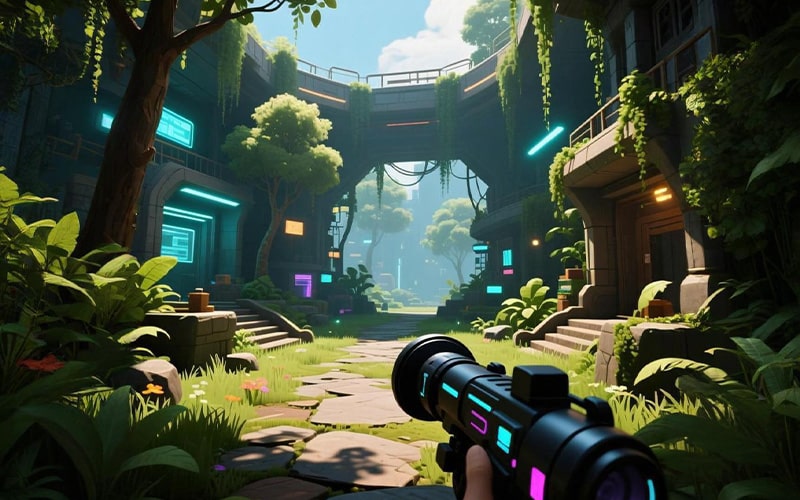
The Complete Development Process of VR Games
1. Idea & Game Concept
Every VR game starts with an idea. Developers define:
- What type of experience it will be (shooting, dancing, flying, racing…).
- Who the players are (kids, adults, families, beginners…).
- The gameplay logic and difficulty level.
- The visual style and atmosphere.
A clear concept helps the team determine the story, setting, and overall direction.
2. 3D Modeling & Scene Design
Once the idea is approved, artists begin creating:
- 3D characters (players, enemies, NPCs)
- Game environments (city, forest, underwater world, space…)
- Props & interactive objects (weapons, cars, buttons, doors…)
All models must meet VR performance requirements, meaning:
- Lightweight enough to run smoothly
- Detailed enough to remain realistic in close-up
- Optimized textures and lighting
For VR, the environment must be designed 360° around the player, so visual quality is extremely important.
3. Animation & Interaction
Next, animators bring all objects to life:
- Character movement
- Enemy attacks
- Driving or flying motion
- Special effects like explosions, water splashes, particle effects
At the same time, developers set up interactions:
- When the player pulls the trigger → gun fires
- When the player touches an object → it reacts
- When the player hits a checkpoint → the scene changes
Good interaction design determines whether a VR game feels realistic and fun.

4. Programming & Game Logic
The development team programs all the gameplay mechanics:
- Player controls
- Game rules and scoring system
- Level progression
- AI behaviors
- Sensor & hardware response (platform vibration, seat movement, wind effects, etc.)
During this stage, the game engine (usually Unity or Unreal) communicates with the VR hardware. This ensures the game runs smoothly on VR machines, motion platforms, and simulators.
5. Audio, Voice & Music
Sound is a key part of immersion. A VR game needs:
- Environmental sound effects
- Footsteps, gunfire, vehicle sounds
- Background music
- Enemy and character voice lines
Good audio design makes the VR experience more realistic and engaging.
6. Testing & Optimization
Before a game is released, developers perform multiple rounds of testing:
- Smooth frame rate
- Clear image quality
- Comfortable player experience without dizziness
- Stable hardware interaction
- Difficulty balancing
Testing helps identify bugs and polish gameplay until it meets arcade-level quality.
7. Final Integration to VR Machines
The final step is integrating the finished VR game into VR devices:
- VR headset compatibility
- Motion platform synchronization
- Seat vibration / air jet / special effects control
- Multi-language support
- Game menu interface and update files
Only after full compatibility testing can the game be safely delivered to customers.

Behind Every VR Machine: Continuous Content Updates Matter
Understanding how VR games are created also explains why continuous content development is so important for VR attractions. A VR machine is not just hardware — the real value comes from the games and experiences that keep players coming back.
That’s why having a team who can keep producing fresh VR content makes a difference for operators.
We have our in-house VR game development team, responsible for designing new games, improving existing ones, and optimizing content for all our VR machines. Our developers regularly update gameplay, add new levels, enhance visuals, and create brand-new VR films and interactive experiences.
For all customers who purchase our VR equipment:
- All VR games and VR movies come with lifetime free updates
- New games and new content are added continuously
- System improvements and bug fixes are included at no cost
- No subscription fees, no recurring charges
This ensures your VR attraction always stays fresh, competitive, and profitable — with new experiences that keep players engaged.